


10 Modern-Day Products That Got Their Start From NASA Technology Advancements
When the Soviet Union’s satellite Sputnik took to the skies in 1957, it launched the space race and a new technological era. In their quest to explore the final frontier of space, the National Aeronautics and Space Administration, also known as NASA, pushed engineers, scientists, and private industry to solve problems no one had ever faced—and to create new technologies the world had never seen.
Many of the things NASA invented didn’t stay in orbit for long before finding their way back to Earth and into the daily lives of the people who live here. In this article, we explore some everyday modern products inspired by NASA and its technologies.
Cell Phone Cameras
Photography is an important part of any space mission, so when NASA needed better cameras in the 1990s, the Jet Propulsion Laboratory developed the complementary metal-oxide-semiconductor (CMOS) image sensor. CMOS sensors convert light into digital image data. Smaller and less expensive than previous sensors, CMOS image technology is now used in modern DSLR and cell phone cameras.
Scratch-Resistant Lenses
Once upon a time, all eyeglasses used lenses made of real glass. Offering crystal-clear vision support, these lenses were, unfortunately, also fragile. Easily shattered, they posed a risk to eye health and safety, something that the Food and Drug Administration recognized in the early 1970s when it issued a legal requirement that all sunglasses and prescription glasses be shatterproof.
The alternative—a plastic lens—was more prone to scratches, but scratch-resistant coating technology developed in the late 1980s to protect astronaut shields from space debris also improved the durability and longevity of civilian eyewear.
Foil Emergency Blankets
Sometimes called space blankets or thermal blankets, foil blankets are often used in emergencies and by outdoor enthusiasts. Shiny, waterproof, and windproof, the lightweight blankets work by reflecting body heat and preventing sweat from evaporating, keeping the wearer warm even in extreme conditions. They can also be used to reflect sunlight away from the body or serve as an emergency signal. The blankets were developed in 1964 for the US space program at NASA's Marshall Space Flight Center in Alabama.
Home Insulation
Like foil blankets, radiant barrier technology was developed as a thin, reflective material. Originally designed for the Echo I satellite to help reflect communication signals back to earth, radiant barrier technology quickly found other uses. Its reflective properties protect spacecraft from extreme temperatures and space radiation. Back on earth, it was quickly repurposed for more domestic applications, including providing insulation for homes and other buildings, hot water tanks, and more.
Cordless Vacuums
You might think your Dustbuster is only good for collecting the popcorn that gathers between couch cushions, but cordless vacuums are among the everyday modern products inspired by NASA. A collaboration between NASA and Black & Decker led to the development of the Dustbuster handheld vacuum in the 1970s. NASA had commissioned the company to produce a simple, self-contained drill for retrieving and collecting moon rocks during the Apollo missions. Black & Decker developed technology that allowed that functionality with minimal power, then used that same technology in the Dustbuster. It’s also used in handheld power tools and medical devices.
Memory Foam
Originally developed to make spacecraft seats safer and more comfortable, memory foam—also called tempur foam—is now used for a wide range of consumer products, from mattresses to shoe insoles. The original memory foam was an open-cell “slow spring back foam” that conformed to the shape of the body, regaining its original shape once pressure was removed. Later innovations refined the material to improve temperature sensitivity and reduce the environmental impact of producing the foam.
Wireless Headphones
Headphone technology had already made impressive strides by the early 1960s, thanks to investments by the airline industry. But when a 1961 re-entry accident forced an astronaut to abandon his communication devices, NASA began looking for ways to cut the cord—literally. NASA’s exploration of wireless communication technology helped advance the systems that would later influence modern wireless headsets and consumer audio devices.
Computer Mouse
Before the mouse was invented, computers were operated using text-based commands and physical inputs like switches and punch cards. While it worked, it wasn’t the most efficient method of navigation. The first mouse, a wired cube on wheels, was invented in 1961 at the Stanford Innovation Lab. Its creator, a man named Doug Engelbart, developed the device while working under a grant from NASA, placing it among the everyday modern products inspired by NASA.
Infrared Thermometers
Traditional body thermometers measure body temperature by direct contact, often placed under the tongue. They’re precise, but slow—and in a medical setting, increase the risk of disease spread through cross-contamination between patients. In the early 1990s, the infrared thermometer, which takes temperature readings from inside the ear or over the forehead, was developed as an alternative. Using the same infrared technology developed by NASA to measure the temperatures of stars and planets in space, the devices were faster and eliminated the need for direct contact.
GPS
The Global Positioning System, or GPS, relies on a complex network of satellites to relay navigational information and positioning data back to Earth. While the overall system was developed—and is still managed—by the US military, it relies on satellite navigation, orbital mechanics, and Earth-measurement technologies advanced in part through NASA’s space research. Those contributions helped refine the precision mapping and positioning systems that eventually put turn-by-turn navigation in the palm of your hand.
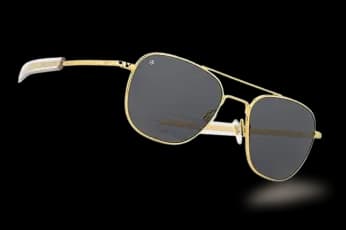
From outer space to everyday life, the inventions NASA has made continue to shape the way we see the world—sometimes literally. You can find that same spirit of performance and durability in American Optical’s complete eyewear collection, featuring the shatter-resistant technology of AOLite™ Lenses.
Learn more about AOLite and explore our complete Eyewear Collection →
10% off your first purchase
Join our email list to be first to hear about new arrivals, limited-edition drops, sales, and more! *Offer excludes new and limited edition items.